The standard workflow of synthetic biology starts with target product confirmation. Based on product characteristics, appropriate chassis cells are selected, followed by genetic circuit design. Designed genetic constructs are transformed into chassis cells for testing and screening; circuits are iteratively revised according to experimental feedback to optimize performance. Repeated rounds of modification ultimately yield optimal cell factories and enable full-scale industrial production. Accordingly, chassis cell engineering and fermentation engineering constitute the two cornerstones of synthetic biology.
Figure 1. Construction Workflow of Cell Factories Based on Synthetic Biology
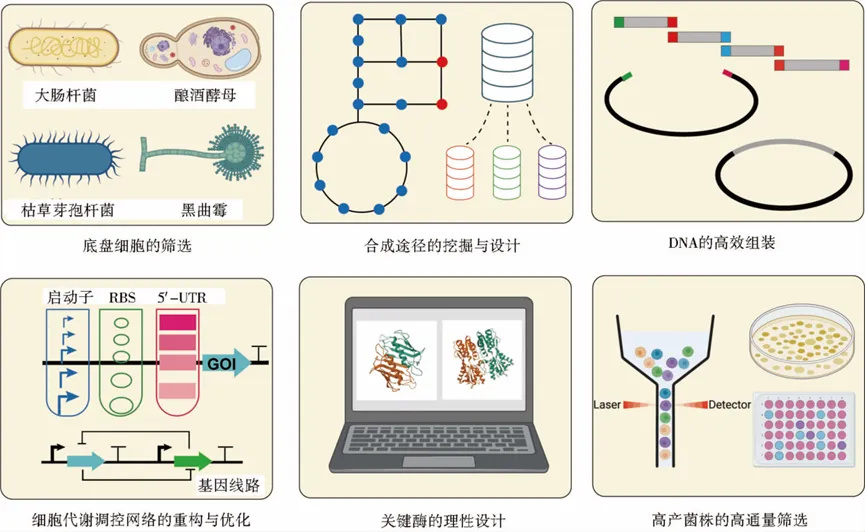
Source: China Biotechnology

Technical Platform Edge: Diversified Chassis Cells
Chassis cells occupy a pivotal position in synthetic biology as host organisms where metabolic reactions proceed. Functional synthetic biological components, gene circuits and metabolic pathways are integrated into chassis cells to realize rational design goals. Chassis cells fall into two categories: model organisms and non-model organisms. Model organisms are thoroughly characterized with abundant mature genetic manipulation tools for exploring universal biological rules. Common industrial chassis strains include Escherichia coli, Corynebacterium glutamicum, Saccharomyces cerevisiae, filamentous fungi and Pichia pastoris.Figure 2. Pros & Cons Comparison of Multiple Chassis Cell Varieties
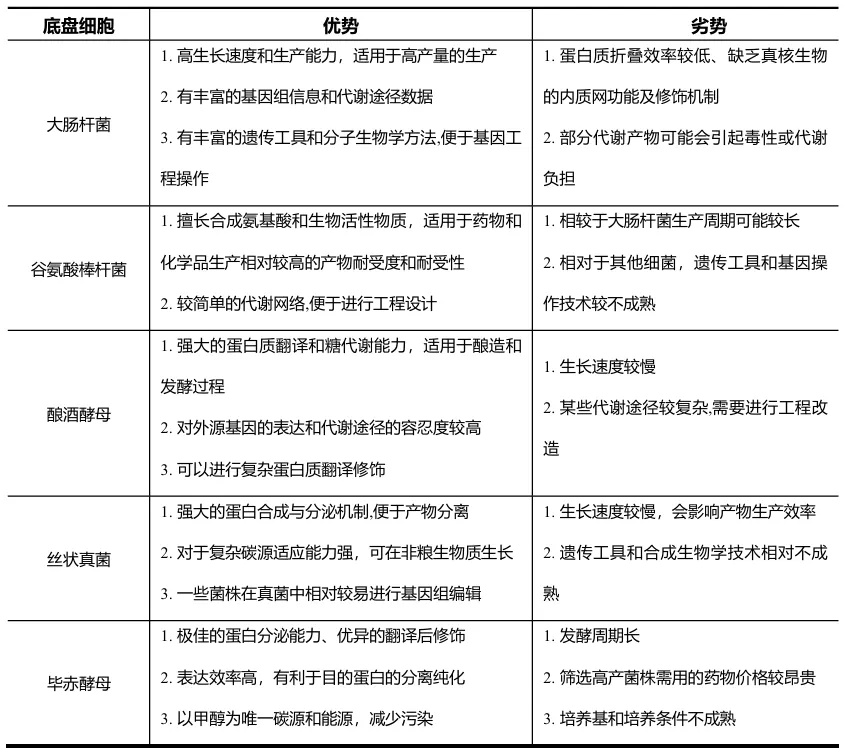
Source: 2023 Synthetic Biology Driven Beauty & Health Consumer Goods Industry ReportStar Chassis Cell: Pichia pastoris
Pichia pastoris is a methylotrophic yeast capable of utilizing methanol as the sole carbon and energy source. Similar to other yeast species, it predominantly exists as haploid cells during vegetative growth; nutrient deprivation triggers conjugation between two physiologically distinct haploid mating types to form diploid zygotes.1. Extraction Process
Collect waste Pichia pastoris sludge → prepare 50 mL suspension with specified NaOH concentration based on dry cell weight → heat-preserved extraction under controlled temperature → centrifugation to remove solid residues → concentrate supernatant, add four-fold volume of ethanol → low-temperature overnight standing → centrifugation for sediment collection → polysaccharide content quantification.2. Developmental Value
(1) Pichia pastoris: High-performance Yeast Expression Host
As a eukaryotic microorganism, Pichia pastoris inherits core merits of advanced eukaryotic expression systems including post-translational modifications such as glycosylation and signal peptide cleavage alongside straightforward lab operations. It outperforms baculovirus and mammalian cell culture systems in cost efficiency, operation speed and target protein yield. Compared with Saccharomyces cerevisiae, it retains convenient molecular manipulation features while delivering 10–100 times higher heterologous protein expression titer.
(2) High-yield Recombinant Strains Available via Genomic Integration
Exogenous genes integrated into Pichia pastoris genome via plasmid insertion feature stable heredity without easy loss; multi-copy genomic integration enables screening of high-expression engineered strains.(3) Strong Promoters for Tunable Heterologous Gene RegulationThe powerful promoter of alcohol oxidase (AOX) gene from Pichia pastoris is widely adopted for inducible and controllable foreign gene expression.(4) Simplified Downstream Purification of Secreted Recombinant ProteinNative Pichia pastoris secretes minimal endogenous proteins into culture broth, making heterologous protein dominant in total extracellular protein and drastically reducing purification workload.The Pichia pastoris platform supports production of high-value medical recombinant proteins, including bovine trypsinogen, human PP2A subunit, Hepatitis B preS1 protein, HEV ORF2 fragment, human IL-2 and Tumor Necrosis Factor. Truncated MT1-MMP (with C-terminal transmembrane domain deleted from oncogenic protease) can be functionally expressed in this yeast, facilitating anti-cancer drug development. Recombinant Type III Humanized Collagen from Beijjing Beijin Medical is also manufactured using engineered Pichia pastoris expression system.
Chassis Cell Optimization
Intrinsic intracellular metabolic and regulatory networks inevitably interfere with artificially introduced biological parts and pathways due to cellular complexity. Systematic multi-dimensional optimization is therefore essential to fulfill synthetic biology design targets.
For model microbes: George Church’s lab developed Multiplex Automated Genome Engineering (MAGE) in E. coli for large-scale genome reprogramming and adaptive laboratory evolution. In 2023, Prof. Huimin Zhao’s group invented RAGE, an RNAi-assisted automated genome evolution toolkit customized for Saccharomyces cerevisiae chassis.
For non-model chassis microbes: Led by Dr. Meng Wang, the team at Tianjin Institute of Industrial Biotechnology, CAS established MACBETH (Multiplex Automated CRISPR Editing for Corynebacterium glutamicum), realizing full-process automation from plasmid construction, genome editing and clone screening to phenotypic validation, enabling thousands of mutant strain constructions monthly. The team also developed droplet microfluidics-based high-throughput cultivation & screening platform for Streptomyces, achieving 10,000 strains screened per hour with over 330-fold single-round enrichment from mixed strain pools.
Key Challenges in Chassis Cell Construction
Multiple bottlenecks hinder microbial cell factory development: over 99% of known microbial species remain unculturable under lab conditions, accompanied by slow proliferation or silent heterologous gene expression. In addition, native secondary metabolite biosynthesis in wild strains typically stays below mg/L level, creating obstacles for isolation, purification and bioactivity identification of valuable natural products.
Core Capacity for Commercial Scale-up: Fermentation Engineering
Lab-developed superior strains undergo lab-scale trial, pilot test and commercial mass production sequentially. Enterprises need robust fermentation optimization and scale-up capability to fulfill high-throughput strain characterization and bioprocess development, bridging lab-scale design to full-volume manufacturing. China owns the world’s largest fermentation industry, accounting for nearly 70% of global fermentation production capacity. As a tech-intensive sector, synthetic biology scaling from gram-level lab synthesis to kilogram and ton-level bulk production demands case-by-case parameter re-optimization, with customized equipment setup and process tuning required at each production tier.Unlike inorganic petrochemical feedstocks with well-defined thermal/pressure physicochemical parameters for standardized production, chassis microbes dynamically shift metabolic phenotypes amid changing cultivation environments. Scale-up poses stringent requirements for metabolic homeostasis and microbial stress tolerance. Production cost drops by 37%–60% whenever fermentation volume expands 10-fold thanks to prominent scale economy, yet process complexity rises synchronously. Parameters including temperature and pH are easily controllable within 1 L bioreactors, whereas 10,000 L fermenters contain tens of thousands of distinct microenvironments affected by microbial metabolism, heat buildup and metabolite accumulation. Mechanical agitation is required to homogenize substrate, oxygen and heat distribution while mitigating microbial contamination risks.Traditional Fermentation Optimization & Scale-up TechnologiesChina boasts centuries of traditional fermentation manufacturing for vinegar, alcoholic beverages and fermented sauces alongside mature bulk commodity fermentation for amino acids, organic acids and nucleotides. Conventional optimization strategies include strain screening, medium formulation, cultivation condition refinement and bioreactor configuration upgrade. Classical strain improvement via natural selection and random mutagenesis underpins industrial domestication of genetically engineered microbes. Early process optimization focuses on static parameters including optimal temperature, inoculation density, pH and C/N ratio, widely applied for antibiotic, organic acid and nucleoside industrial fermentation. Hardware innovations cover impeller redesign, aeration modification and air-lift bioreactor development for shear-sensitive filamentous fungi to elevate volumetric productivity.Core Enabling Technologies for Fermentation Optimization & Scale-upFermentation engineering core lies in mapping correlations between operational parameters and microbial physiology to redirect cellular metabolism toward target metabolite accumulation, with real-time biosensing as indispensable infrastructure. Off-gas analysis represents the most impactful sensing tool; during ARA scale-up at Cargill Biotech, RQ (respiratory quotient) monitored via exhaust gas coupled with staged nitrogen feeding successfully scaled the bioprocess into 200 m³ fermenters, boosting final titer from 11.93 g/L to 16.82 g/L and cutting production cost by 11.2%. Recently developed intracellular fluorescent biosensor technology pioneered by Prof. Yi Yang from East China University of Science and Technology enables real-time quantification of NADH, NADPH and intracellular amino acids; integrated with online process analytics, it achieves precise dynamic monitoring and predictive control of cellular metabolism.Equipment for Fermentation Optimization: Development & Adoption of High-throughput Parallel Bioreactor PlatformMiniaturized parallel bioreactors replicating industrial cultivation conditions are critical to boost experimental throughput for rapid bioprocess screening.Synthetic biology boom fuels rapid advancement of automated high-throughput screening hardware covering agar plating, colony picking, microplate incubation and in-well online detection, drastically accelerating post-construction strain screening. Automated Biofoundry platforms support up to ten million strain screenings daily. Chinese firm Tianmu Biotech leads domestic R&D of automated feeding and online sampling analyzers with wide commercial deployment across research institutes and biomanufacturers.Digital Twin: Next-generation Core Tech for Intelligent FermentationBig-data-driven intelligent upgrading reshapes modern fermentation. Completed digital infrastructure and industrial digital transformation promote digital twin-based simulation, predictive modeling, autonomous process tuning and intelligent scale-up.Multinational corporations including GE, DSM, Siemens and top European universities (TU Delft, DTU, Imperial College London) invest heavily in fermentation digital twin R&D. Austrian startup Novasign optimized E. coli SOD fermentation using hybrid-model digital twin platforms. Chinese academia advances related research via international cooperation: East China University of Science and Technology collaborated with TU Delft & DSM to build an integrated digital model linking reactor fluid dynamics with penicillin-producing Penicillium chrysogenum kinetic data for industrial bioreactor downsizing design and process optimization.Future AI integration will revolutionize conventional fermentation workflows; digital twin will become standard industrial infrastructure paired with knowledge graph-enabled intelligent process diagnosis and automatic optimization to underpin sustainable bioeconomy. Green manufacturing is prioritized for large-scale fermentation, including non-food biomass feedstock (agricultural straw, forest residues), reagent-free clean production, low-carbon/low-emission/low-pollution biomanufacturing and biological carbon fixation.
Conclusion
Investment in synthetic biology follows the core logic: Short-term returns rely on premium product portfolio; long-term value derives from platform capability. In the short run, prioritize cost-advantaged products with mature or fast-growing market demand; for long-term layout, evaluate enterprises’ scalable platform innovation powered by diversified chassis engineering, automated workflow and AI-enabled fermentation technology.
References
[1] Zhu Meiqiao. Synthetic Biology Reshapes Fermentation Industry[N]. China Food News, May 18, 2023.
[2] Wang Qing, Mao Yin, Zhao Yunying, et al. Biosynthesis of 2-phenylethanol via aroma-producing yeast bioconversion[J/OL]. Food and Fermentation Industries, 1-10, 2024-05-14.
[3] Liu Fufeng, Liu Xuzhi, Li Jinbi, et al. Metabolic pathway optimization aided by biological retrosynthesis tools[J/OL]. Progress in Chemistry,1-10,2024-05-14.
[4] Li Hanchun, Wang Xin, Qu Xudong, et al. Advances of Synthetic Biology in Pharmaceutical Industry[J]. Shanghai Pharmaceutical Journal,2024,45(07):24-31+55.
[5] Geng Tingting. Tiny Microbes Power Giant Industrial Upgrade[N]. Qingdao Daily, Mar 31,2024.
[6] Wang Zhu, Sun Feifei, Zhang Yu. Research Progress of Chemo-Synthetic Biology[J/OL]. Chinese Bulletin of Life Sciences,1-28,2024-04-26.
[7] Alves L C, Deng Z, Kermeci N, et al.Integrating microfluidics and synthetic biology: advancements and diverse applications across organisms.[J].Lab on a chip,2024.
Source: In-depth Industrial Research Institute
Original link:https://mp.weixin.qq.com/s/xFJoD_0Wbv1hpt1oCf9WNQ